
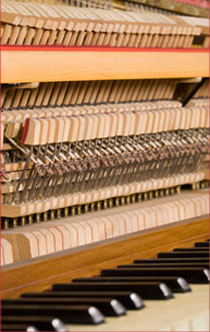

Tuning
(770) 570-0356
contact@PrimePianoServices.com

Book Your Tuning Appointment Today!
$ 95.00 For Full Pitch Raise
Repeat Biz New Price Discount on T1
See Specifics Below & Card Charges
Closed Sundays & Mondays
Russ honors Georgia's Hands Free Driving Law and does not to take calls when driving, and he tries not to take calls while in the customer's home tuning, but he's still easy to reach.
Email - Text - Voice Mail
Texting & Email are the most reliable.
Area of service –
As a resident of Gwinnett County, Russell's primary area of service is focused on Atlanta, and the North Metro surrounding areas. See the Areas of Service Tab for your county.
Quick Note 1 - My Busy Season runs November through June. So, please plan in advance. And thank you for the patience. And for those who have followed my journey of caregiving over the years for my Parkinson's dad, he left this world on November 13, 2025. He was a very devoted father and deacon emeritus at First Baptist Church Duluth. He will be sorely missed. He was 93 years old.
Quick Note 2 - Effective January 2, 2027, I will no longer be offering Teacher Discounts, Large Fleet Discounts (No contract large fleets will end effective by 7.1.2026), Institutional Discounts, Repeat Biz Discounts, or Multiple Piano Discounts. Plan and inquire accordingly to take advantage of those for 2026. Currently, I have no plans to increase my standard tuning fees for T1 & T2. My current Technical Services hourly rate will also remain the same for 2027. I usually allow up to 60 miles round trip for my local tunings, but beginning 2027 I will calculate for fuel beyond that range. I reside in Duluth, GA. You can go to Google Maps to test your round trip considerations. So, customers in Jefferson, please keep that in mind. I'm still pondering my senior citizens in their 80s & 90s, as well as customers and dear friends who've been with me now 15-20 years plus. Thank your for your patience as this sorts out.
Quick Note 3 - For 2026: "I'm a new, first time customer. How much will my tuning cost and how do I pay?" The range of cost on your first tuning visit will be $175.00 to $270. Please, budget 2 hours for your first visit. Younger generations frequently use Zelle. I still see plenty of checks. And cash is almost as frequent as Zelle. See details below.
Quick Note 4 - "I'm a returning, repeat biz customer. How much will my tuning cost?" You can expect 3 different brackets now: $165.00, or $195.00, or $225.00. For example, if I start at 10.30am and leave by noon? That's $165.00. If I leave by 12.15pm, then that's $195.00. But if it takes a full 2 hours, then that's $225.00. See details below.
Quick Note 5 - For the remainder of 2026, for First Time New Customers: If a teacher or school has referred my services to you, PLEASE put that on my radar!
How much does it cost to tune a piano? –
NOTE: New Pricing Structures Coming January 2, 2026
Effective January 2, 2026, the 2024 through
2025 price structure is being retired and replaced.
In general, I base my price structure on the amount of time that
will likely be spent in the home or job site. When I make a tuning visit,
I may need to tune your piano 1 time or 2 times during that SAME visit
depending upon the condition of the piano. Your tuning cost may be
$175.00, or $270.00 for that day's tuning service. And Repeat
Biz Customers will be grandfathered in with a thank you discount. Here is
how it breaks down for payments by either cash, check, or Zelle:
- SR1 (2026) - Special Rate Discount (See Details Below) = DEDUCT (-$15.00)
- T1 (2026) - Basic Finish Tune (1.25 to 1.5 Hours) = $175.00
- T2 (2026) - New Customer Full 220-Pin Pitch Raise = $ 95.00
- NPT (2026) - Repeat Biz New Price Transition thru Sept. 2026 = DEDUCT (-$10.00)
- ET1 (2026) - Extra Time Upcharge - Additional 15 Minutes = ADD $30.00
- ET2 (2026) - Extra Time Upcharge - Additional 30 Minutes = ADD $60.00
- TS (2026) - Technical Services Provided Per Hour = $125.00
- DOA (2026) - Dead on Arrival Piano & Consultation Visit = $125.00
- CS (2026) - Concert Tuning Services - Please Call To Determine = TBD
This does not mean
that I will need to come to your home multiple times. The prices above are for
a one-time only tuning visit. If the following information feels confusing,
please feel free to call or text me at (770) 570-0356. Your input will help me
refine how to rewrite this pricing information. I will advise you when you
should expect to retune your piano - 6 months or 1 year etc.
For Credit
Card & Debit Card Purchases, I use Square.com to
process the payment. Below are the upcharges required to cover the swipe
charges (Visa, MasterCard, American Express, & Discover):
· T1 (2026) - Basic Finish Tune Service (per piano) ADD $ 7.00
· T2 (2026) - Basic Pitch Raise + Basic Tune ADD $ 9.00
· DOA (2026) - D.O.A. - Dead On Arrival Pianos ADD $ 5.00
· Add 3.5% for additional services and hourly repairs.
Service Descriptions -
How do piano techs measure a piano? Depending on the piano, I use an app on my iPad called Tune Lab or Piano Scope to get an idea of the
present pitch position of a piano prior to tuning. You may hear a piano
technician use the words “Your piano is 10 cents sharp” or “Your piano is 25
cents flat.” But what does that mean? In our industry, a single piano
key is assigned the value of 100 cents. Just like a single Dollar has the
corresponding value of 100 cents. For example, most pianos will move
around 8 cents if tuned once per year. And I have some pianos in churches
that jump 25 cents between seasons. And a piano that has not been tuned in
10 to 30 years will easily be out of tune between 50 cents to 100 cents flat on
average. When we see a piano that is 100 cents flat, we use the expression
“it is one full key flat.” If you have a guitar tuner, it may give you an
idea what the pitch position of the piano is. Choose a note on the piano
that corresponds to a note played on the guitar. What does it
read? Customers are welcome to observe while I take the measurements.
All pianos are created differently, and each has its own individual needs. For
pianos that are regularly maintained, an owner can anticipate a standard,
one-pass finish tuning visit that will require 1hour 15 minutes to 1.5
hours. In contrast, for instruments that do not receive annual or bi-annual
tuning visits, an owner may need to budget additional time and money for
multiple tunings to get reliable service. Prior to tuning, your piano
will be measured with a computer to determine its present pitch position.
- SR1(2026) Piano - Special Rate Tuning Discount - Beginning January 2026, this rate will be offered only to a limited audience:
- Super Seniors in their 80s and 90s. Please Note: First time Super Senior customers may have a piano requiring a Full 220-Pin Pitch Raise. That particular upcharge may still apply. And depending on the time required for repairs, we may need to discuss that situation. Even though I am approaching my late 60s, I feel a personal responsibility to encourage our Super Seniors to stay engaged with life.
- Friends and Family.
- Long Time Repeat Biz Customers who would appreciate the one-time discount while they consider their options.
(Note: No Additional Discounts may apply for the SR1 - Special Rate Tuning Service) - T1 (2026) Piano - Basic Finish Tune Service Visit is normal for the Regularly Maintained Piano. These are pianos tuned typically tuned once per year - 1 tuning @ 1hr 15min to 1hr 30min = $175.00 or Repeat Biz Customer @ $175.00 - $10.00 = $165.00. !!NOTE: If you tune twice per year, see SR1 above!! A typical T1 Tuning Visit requires 1hr-15min to 1hr-30min to tune. Pianos that require additional time to tune and stabilize will be assessed an upcharge based on 15-minute blocks of time. See ET1 & ET2 Upcharge Details below.
- T2 (2026) - Full 220-Pin Pitch Raise Service - I see the highest volume of these in December. This will apply to all first-time customers whose pianos measure 18cents flat or sharp. However, the more radical and more likely first-time visit is a piano that hasn't been tuned in 30-40-50 years. These pianos typically range from 80 cents to 200 cents flat. They are brutal to tune and are real shoulder killers. Typically, I do not apply this level of upcharge to repeat biz customers. So a first-time customer can expect this cost range to apply - $175 + $95 = $270.00 if paying with checks, cash, or Zelle TXFR, and ADD $10.00 for credit card processing. Repairs are calculated separately. For this level of service, I may be in the home up to 2 hours. The T2 Piano requiring more than 2 hours may be assessed an ET1, ET2, or Repairs Upcharge due to the additional workload.
- NPT (2026) - Repeat Biz Customer New Price Transition - My T1(2026) Repeat Biz Customers will receive a $10.00 Discount. Currently, I plan to extend the NPT through September 2026. I will reassess this at the beginning of the new school year. NOTE: This discount does not apply to the SR1(2026) Special Rate.
- GCMTA T1 (2026) - Gwinnett County Music Teachers Association - If you are a member of the GCMTA, MTNA, a home-based piano teacher, school, or large-fleet organization of 10(+) pianos, you are welcome to reach out and chat.
- ET1 & ET2 (2026) - Extra Time Upcharge (15min & 30min Blocks of Time) - Every home is different. A piano may be on an outside wall, next to windows, over or directly under an HVAC supply vent. This is especially true in churches where a piano is on top of a 4' wide supply vent. Buildings may be extra humid or dry. Every customer's needs are different. Some piano owners will tune 4 times per year; whereas, others may wait 4 years. And every piano is different. Some hold solid and the pitch floats together over the year nicely; whereas, a lemon piano will be out of tune in 2 weeks. Every tuning pin is different. Soundboards may be loaded with moisture in July and will be sharp, but then they are cooked dry after weeks of non-stop heaters running from frigid temps and days of 18F polar vortex visits. Sections of the piano may need to be raised sharp, while another section will need to be adjusted flat. These conditions are beyond the technician's personal control and will add work time. I have my methods that I refer to as Adaptive Speed Pitching. I see this frequently with Repeat Biz Customer pianos. Normally, I do not assess a T2 upcharge on returning customers unless they have waited like 4-5 years. But since I see pianos that need modified pitch raises or light repairs, beginning in 2026 I will assess an extra time upcharge. Steinway customers, please note that most Steinway grands require at least 1hr 45min to tune. I find Steinway & Sons customers to be much more pitch sensitive and will require more ear tuning techniques. Kawai grand owners of the GE-Series, GS-Series, KG-Series, and the RX-Series will likely see an extra time upcharge. These particular models have a section from D#5 to C8 that are THE most difficult sections to stabilize in the industry. They are time consuming and brutal to tune. I cut my teeth on the KG-Series beginning in 2007. It took many years to learn how to get them to hold and float together. So, please call if this sounds confusing.
- TS (2026) - Technical Services and Repairs - On site technical services and repairs are assessed on an hourly basis. However, I may use the ET1 or ET2 category to keep life simpler. Some fixes have to be done on the fly just to complete a tuning visit and the work time from those will accumulate. When there are times that the customer needs to be made of aware of the actual repairs, then we will discuss that before proceeding. For example, lubricant on a stiff hinge/flange may fit the moment, but the offending part(s) may need a real, time consuming repair visit instead, and the same part could be malfunctioning 3 days later. So, the possible temporary fixes will come with a heads up disclaimer that a real repair visit may be the best course of action, and they will need to call me to schedule the appointment if it acts up again.
- CS (2026) - Concert Tuning Services - In most circumstances, Russell does not step into the Concerts, Artists, and Artisan Piano Technician Services Lane. His preferred lane is the General Services Piano Technician. However, there are real occasions when the local artisan techs are booked out and are not available to assist. So, Murphy’s Law is the risk. For example, there is one highly specialized field repair that Russell may not be adequately equipped to provide. A case in point may be failed and broken agraffes. It’s a rare repair, but when they break, it will likely be moments before an artist’s performance. Concert venues are welcome to reach out to Russell when their preferred techs are not able to assist. We can certainly discuss your particular needs and see if Russell can be of assistance.
What is not included in the Tuning Service fees? -
The Tuning Fee only applies to the tuning process and product. Repairs
for sticky keys, broken strings, vacuuming, cleaning, applying lubrication to
sluggish action parts etc. will be assessed separately, and are costs
beyond the tuning service. When repairs are performed during the tuning visit, the
current hourly rate stated on the Repairs tab will be applied to
cover the cost of the additional services. Please review Repairs and the TS (2026) paragraph above for more
information.
When will we need to tune again? -
I have some customers who are very, very pitch sensitive artists, and
they may book as many as four piano tunings per year to cover their needs. I have some pianos that do a serious jump in
pitch as the heaters and air conditioners adapt the spaces to the relative
humidity levels. Those pianos I usually
suggest tuning after July 4th as that marks the return of summer
levels of humidity. And those pianos
change once again when the heaters turn on and dry out the air. The start of winter can vary. In my younger years, it started in November,
but now winters may not really bite until February. So, in some cases, biannual tunings are quite
routine.
As a general rule of
thumb, I tell customers that if the piano bugs you in 6 months, reach out to
schedule a tuning visit. Otherwise, plan
on tuning your piano at least once per year as long as the piano is being used. Try NOT to wait past 24 months to tune again.
And finally, I do have customers who wait 3 to 5 years between tunings. When resources are tight, or the piano has
been sitting unused for a long time, then I totally get it. But be aware!! I may have to treat the piano as a T2
Typical 1st Tuning Visit.
Appointment Times -
Please see my Business Hours tab for specifics. I am a full-time piano technician. I am
open to schedule tuning and other services to fit your schedule. I like
to keep Sundays open to nurture my own spirit and I usually close on Mondays to
do all the catch-up work around the house, but I will consider special requests
and needs.
Price Changes and Price
Structures -
Over the years, I have tried to adjust prices every 3 years. I plan to hold current price structure will be in place
from January 2, 2024 until December 31, 2026 depending on how the economy is trending. I may
modify them to adjust to market forces and inflation. Fingers crossed that our Congress, the Treasury Secretary, the Federal Reserve, and our POTUS do better jobs at managing the economy than they have in the past.
Owner’s Risks (Good
News and Bad News) -
As piano owners, there are two risks that are always present. Metal either
stretches or it breaks.
· String Breakage - With instruments that are not tuned regularly, or they have acquired rust, there is the ever-present risk of string breakage. All products have a life cycle. Whether clarinet reeds, trumpet valves, drumsticks, or music wire, man-made objects eventually go into a state of decay. Piano wire basically has an 8-year life span. After that, metal fatigue is a reality. All precautions will be taken to avoid breakage (i.e., the application of lubrication at friction points).
· Plate Breakage - The second concern that all piano owners face is plate breakage. Since the late 1800s pianos have been manufactured with cast iron plates that provide the piano with sufficient structure to resist the force of highly tensioned piano wire. Despite refined quality controls, occasionally a plate is installed that either has an inappropriate mix of ore or it was not properly cooled once it was poured into the mold. Hence, weak points were inadvertently created during the manufacturing process. One of Russell's acquaintances has been tuning for more than 40 years. During the span of his career, only one plate has broken. Though a rare occurrence, it can happen.
So, there is good news and bad news about the above. The good news for broken
strings, most of those situations can be repaired. Unfortunately, the bad news
for plate breakage is that the piano is done if/when the plate has had enough.
If the plate breaks, the piano may be a great piece of furniture, a perfect
place for potted plants, or it can be converted into an ingenious media center.
The Piano Technician’s Disclaimer -
Piano technicians DO NOT
break strings and plates. Strings and plates break.
Thanks for visiting!
"Mr. Rusty"